
Let’s talk about that crusty white gunk in your tea kettle.
You’ve seen it. That chalky film on the bottom. Those weird little flakes that hitch a ride into your teacup and make your tea taste like you licked a chalkboard. Not exactly the cozy cup you were going for.
Here’s the happy news: getting rid of it is stupidly easy. No special gadgets, no trip to the store, no elbow grease. Just some stuff you’ve already got lying around and about an hour of doing basically nothing.
Ready? Let’s get that kettle sparkling. Here’s exactly how to descale a tea kettle — step by step.
Contents:
The Super-Quick Version (for the Impatient)
Fill your kettle halfway with equal parts water and white vinegar. Boil it. Let it chill for 20 minutes to an hour. Dump it, rinse it, then boil some plain water to ditch the vinegar smell. Boom. Clean kettle.
Want the details and a couple of other options? Keep reading. It’s short, I promise.
Wait, What Even Is That White Stuff?
It’s called limescale, and it’s not dirt, so don’t feel gross about it. It’s just minerals.
Hard water (basically water packed with calcium and magnesium) leaves this stuff behind every time you boil. And here’s the kicker: most of the U.S. has hard water. So if your kettle turns into a little science experiment every few weeks, relax. It’s not you. It’s your tap.
But it’s worth cleaning, and not just for looks. That crust makes your tea taste kinda blah, and it forces your kettle to work harder and slower, which quietly runs up your energy bill. A clean tea kettle boils faster and lives longer. Everybody wins.
Method 1: White Vinegar (the Old Reliable)
This is the classic move. It’s cheap, it works like a charm, and there’s a 99% chance there’s a bottle of vinegar in your kitchen right now.
Quick rule: use plain white vinegar. Not the fancy apple cider stuff. It’s weaker, and it can stain the inside of your kettle. Save the good vinegar for your salad. Vinegar is a real kitchen workhorse — it can even help you get sticker residue off clothes.
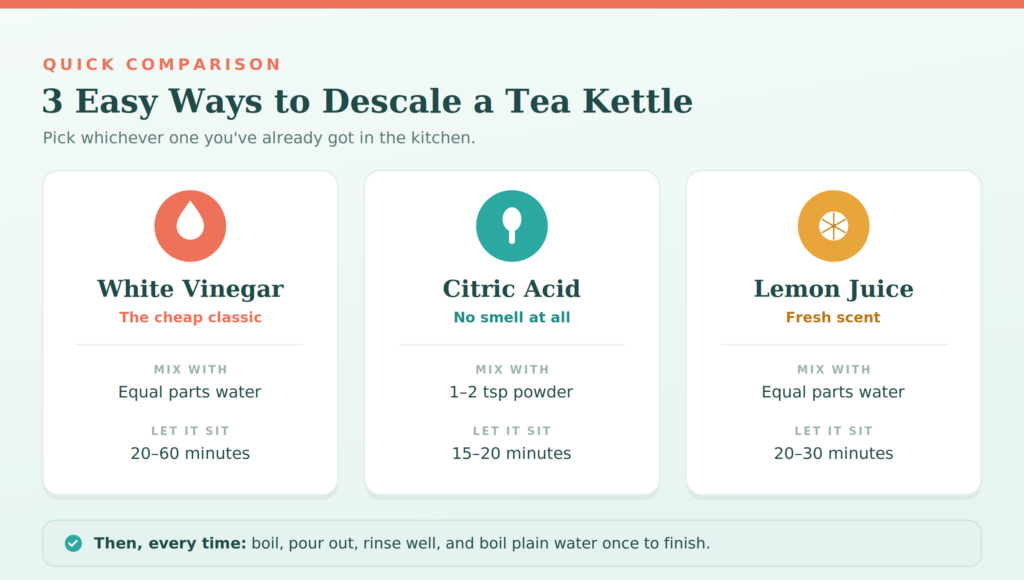
- Mix it. Fill the kettle about halfway with equal parts white vinegar and water. Roughly a cup of each does it. Just make sure the liquid covers all the crusty bits.
- Boil it. Flip the switch (electric) or park it on the stove (stovetop) and let it come to a boil.
- Ignore it. Turn it off and walk away for 20 minutes to an hour. Go watch something. The longer it sits, the more scale it melts away. Really nasty buildup? Give it the full hour.
- Dump and wipe. Pour it out. If a few bits are being stubborn, swipe them off with a soft sponge.
- Rinse. Give the inside a good rinse two or three times.
- De-vinegar it. Fill it with plain water, boil, and toss that out too. This kills the vinegar smell so your tea doesn’t taste like a pickle. Still catch a whiff? One more plain boil and you’re golden.
Method 2: Citric Acid (the No-Smell Hero)
Not into the whole vinegar-smell thing? Meet citric acid. It’s my personal favorite, honestly. It’s a natural acid from citrus fruit, comes as a plain white powder, and leaves zero smell behind. Which means you can skip those extra rinse-boils and get on with your day.
You’ll find it in the baking or canning aisle at a lot of grocery stores, or online. Just grab the “food grade” kind.
- Sprinkle it in. Drop 1 to 2 teaspoons of citric acid into the kettle.
- Add water. Enough to cover the gunk, usually about halfway.
- Boil. Bring it up to a boil, then switch it off.
- Chill. Let it sit 15 to 20 minutes. Heavy buildup? Give it an hour.
- Rinse and done. Pour it out, rinse a couple times, and that’s it. No smell, no extra steps. Love that.
Method 3: Lemon Juice (the Fresh One)
Out of vinegar and citric acid? A lemon’s got your back. Works the same way, and bonus: your kitchen ends up smelling amazing.
- Mix. Fill halfway with equal parts lemon juice and water. Fresh or bottled, doesn’t matter. Feeling fancy? Toss in a couple lemon slices.
- Boil. Get it boiling, then turn it off.
- Wait. Let it sit 20 to 30 minutes.
- Rinse. Dump it, rinse well, and do one quick plain-water boil.
Electric or Stovetop? Two Tiny Things to Know
All three tricks work no matter which kettle you’ve got. There are just two little things worth remembering.
Got an electric tea kettle? Unplug it first. And whatever you do, don’t dunk the base or the plug part in water. Water plus electricity equals a bad time. If there’s a little mesh filter in the spout, pop it out, soak it in the same solution, then rinse and dry it before it goes back in.
Got a stovetop kettle? You’ll boil it on the burner instead of pushing a button. That’s the whole difference. Just go easy on the outside if it’s enamel or ceramic, and keep the scratchy scrubbers away from it.
Quick Heads-Up: A Few Don’ts
Descaling is about as safe as chores get, but do dodge these:
- Never mix this stuff with bleach. Vinegar, lemon, citric acid… none of them should ever meet bleach or a bleach cleaner. That combo makes nasty fumes. Hard pass.
- Put the steel wool down. Rough pads scratch up the metal. A soft sponge or brush is all you need.
- Don’t dump baking soda into the acid. It cancels the whole thing out and does nothing. (Want to use baking soda? Cool, just use it solo for stubborn stains.)
- Rinse like you mean it. A few good rinses so there’s no leftover cleaning taste.
How Often Do You Actually Need to Do This?
Depends on your water.
Hard water? Once a month is a good target. Use your kettle a ton? Every couple weeks, even better. Soft water? You can chill and do it every one to three months.
Easiest rule ever: if you can see white film or flakes, it’s time.
How to Keep the Gunk From Coming Back
You can’t fully outrun limescale on hard water, but you can seriously slow it down:
- Empty it after each use. Don’t let water sit in there overnight. That’s prime scale-forming time.
- Only boil what you need. Re-boiling the same water over and over just makes buildup worse.
- Use filtered water. A basic filter cuts the minerals before they ever hit the kettle.
- Wipe it dry now and then. Takes five seconds, keeps things fresh.
A Few Quick Questions People Always Ask
Is descaling with vinegar actually safe?
Yep. It’s a mild acid and totally fine for most kettles when you use it right and rinse after. Not sure about yours? Peek at the manual.
Will my tea taste like vinegar?
Nope, not if you rinse a few times and do one plain-water boil first. Clears right out. Want to skip the smell completely? Go with citric acid.
Can I just use apple cider vinegar?
Better not. It’s weaker than white vinegar and can stain the inside. Stick with plain white.
How do I know it worked?
The flakes come loose and the inside gets shiny again. A couple plain boils flush out any leftover bits.
Can’t I just… leave it?
You could. But it makes your drinks taste dull and your kettle work harder (hello, bigger energy bill). A quick clean here and there keeps it happy.
Bottom Line
Descaling a tea kettle sounds like a hassle, but it’s really just boil, wait, rinse. Grab whatever you’ve got, vinegar, citric acid, or a lemon, and in about an hour you’ll have a clean kettle and way better tea.
Do it once a month, empty it after each use, and that chalky gunk basically becomes a non-issue. Alright, go put the kettle on. You’ve earned a cup.