Maybe the razor slipped. Maybe a trend on your feed talked you into it, or you were trimming a few stray hairs and took off more than you meant to. However it happened, you’re now staring at a thinner brow in the mirror and asking the only question that matters: how long until this fixes itself?
Here’s the reassuring part. Shaved eyebrows almost always grow back, and usually faster than you’d think. The full picture takes a little patience, but you’re not looking at permanent damage.
Let’s break down exactly what to expect, week by week, plus what speeds things up, what slows them down, and the one stubborn myth you can finally stop believing.
Contents:
The Short Answer
For most people, shaved eyebrows follow a fairly predictable path:
- Within a few days: You’ll notice fine stubble starting to poke through.
- 1 to 2 weeks: Short new hairs become visible, though the brow still looks sparse.
- 4 to 6 weeks: Most of the regrowth has filled in, and your brows start looking like themselves again.
- 2 to 6 months: Full density and length return, especially if you shaved off an entire brow.
The reason shaved brows bounce back relatively quickly comes down to one thing: shaving only cuts the hair at the surface. The root that actually produces the hair stays completely untouched.
Don’t miss out to see 10 Dazzling New Year Nail Designs that will make you look most amazing person of the party.
Why Shaved Eyebrows Grow Back Faster Than Plucked or Waxed Ones
This is the detail that changes everything, so it’s worth understanding.
When you shave, the blade slices the hair off right at skin level. The follicle — the tiny pocket under your skin where each hair is built — isn’t disturbed at all. It just keeps doing its job, pushing the same hair back up to the surface. That’s why you’ll often see stubble within days.
Plucking and waxing are a different story. Both yank the entire hair out by the root. Now the follicle has to start from scratch, which takes longer. And there’s a catch: doing this over and over, for years, can stress or damage the follicle to the point where it slows down or even stops producing hair. That’s how some people end up with permanently sparse brows from decades of over-tweezing.
So if you’re going to remove your brows knowing they’ll grow back, shaving is actually the gentlest option for the follicle. The trade-off is that you’ll be doing it more often, since the hair returns sooner.
Understanding Your Eyebrow Growth Cycle
Every hair on your body, including your brows, moves through a repeating cycle with a few distinct stages: a growth phase, a brief transition phase, a resting phase, and finally a shedding phase before the cycle starts over.
The key thing about eyebrows is that their growth phase is short. The hair on your scalp can stay in active-growth mode for several years, which is why it can reach your waist if you let it. Your eyebrows, on the other hand, only spend a matter of weeks to a couple of months actively growing before they slow down, rest, and eventually shed. The whole cycle runs somewhere around three to four months.
That short growth window is exactly why eyebrows stay short and tidy on their own, and you never have to “cut” them the way you trim scalp hair. It also explains why regrowth can feel uneven at first — at any given moment, your individual brow hairs are scattered across different stages of the cycle. Some are growing, some are resting, some are getting ready to fall out. They don’t all march back in formation at the same time.
Your Eyebrow Regrowth Timeline, Stage by Stage
Wondering what’s normal at each point? Here’s a realistic look at how the weeks tend to unfold after you’ve shaved.
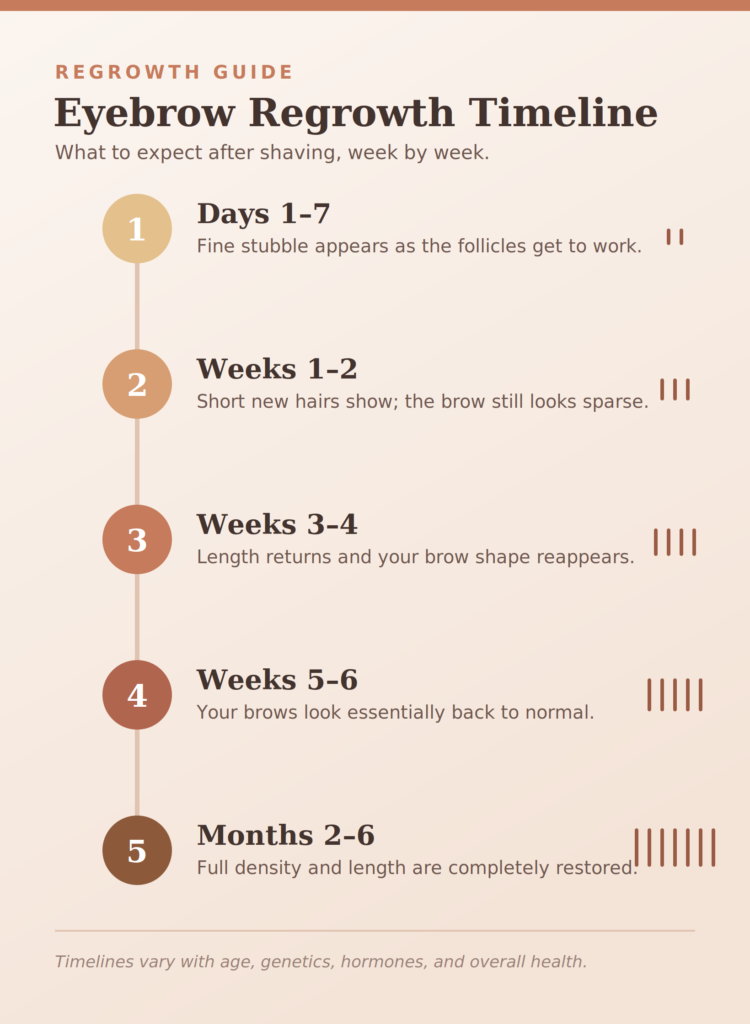
Days 1 to 7. The first signs show up fast. Run a finger over the area and you’ll likely feel rough stubble within three to seven days. It won’t look like much yet, but it’s proof the follicles are working exactly as they should.
Weeks 1 to 2. Those stubbly hairs gain a little length and start becoming visible rather than just touchable. The brow still reads as thin or patchy at this stage, and that’s completely expected.
Weeks 3 to 4. This is when things start looking encouraging. You’ll have noticeable hair with real length, and the overall shape of your brow begins to reappear. Many people feel comfortable skipping the brow pencil around now.
Weeks 5 to 6. For most people, the brows look more or less back to normal in everyday terms. The bulk of the regrowth has happened.
Months 2 to 6. True, complete restoration — every hair grown back to its original length and the full original density — can take a few months. If you shaved off an entire eyebrow rather than just thinning it, lean toward the longer end of this range. In a small but often-cited study where participants fully shaved one eyebrow, everyone had complete regrowth by the six-month mark, though it took a bit longer for someone with naturally light, sparse brows.
If your timeline runs slower than this, don’t panic right away. Plenty of normal factors can stretch it out, which brings us to the next part.
Does Shaving Make Your Eyebrows Grow Back Thicker or Darker?
Short answer: no. This is one of the most persistent beauty myths out there, and it simply isn’t true.
Shaving has zero effect on the thickness, color, or speed of the hair that grows back. It can’t, because everything that determines those traits happens at the root, deep under your skin — and the blade never reaches it. Your genetics and hormones decide how thick and dark your brows are, not your razor.
So why does regrown hair feel coarser and look darker at first? It comes down to the shape of the cut. A hair that’s never been shaved has a soft, tapered tip that thins to a fine point. When you shave, you slice straight through the middle of the hair, leaving a blunt, flat edge. That blunt tip feels stubbly to the touch and can look more obvious against your skin as it grows in. It’s the same hair it always was — you’re just seeing it cut at its thickest point instead of its naturally fine tip. As the hair grows out fully, that impression fades.
Bottom line: shaving won’t give you bolder brows, and it won’t ruin them either.
What Affects How Fast Your Eyebrows Grow Back
Regrowth isn’t one-size-fits-all. A handful of factors can nudge your timeline faster or slower:
- Age. Hair growth naturally slows as we get older, so younger people often see quicker regrowth.
- Genetics. If your family tends to have thick, fast-growing hair, your brows will likely follow suit. Naturally fine or sparse brows take longer to look full again.
- Hormones. Hormonal shifts have a big influence on hair. Thyroid problems in particular — both an underactive and an overactive thyroid — are well known for causing brow thinning and slower growth.
- Nutrition. Your body builds hair out of what you feed it. A diet short on protein, iron, or key vitamins can drag down growth across the board.
- Overall health. Stress, illness, and certain medications can all temporarily push more hairs into the shedding phase and delay regrowth.
- Follicle condition. If the area has a history of heavy waxing or plucking, the follicles may be less efficient than untouched ones.
How to Help Your Eyebrows Grow Back Faster
There’s no magic switch that doubles your growth rate — hair grows at the pace your follicles set, roughly a millimeter or so a week. But you can absolutely create the best possible conditions for healthy regrowth.
Leave them alone. This is the most important and most ignored tip. Resist the urge to “clean up” or reshape while they fill in. Every hair you pluck restarts that follicle’s clock and can make the regrowth look patchier for longer.
Eat for your hair. Protein, iron, zinc, biotin, and vitamins like A, C, and E all support healthy hair. A balanced diet does more for your brows than almost anything you can buy.
Try a nourishing oil, carefully. Many people swear by gently massaging the brow area with oils like castor, coconut, or jojoba. The hard evidence is thin and mostly anecdotal, but a light massage does boost circulation to the area, and the oils keep the skin conditioned. Just be extremely careful to keep any oil out of your eyes.
Consider a brow serum. Some serums are formulated with peptides, vitamin E, and other conditioning ingredients meant to support the brow area. Results vary, so set realistic expectations and patch-test first if your skin is sensitive.
Be patient and consistent. Whatever approach you choose, give it weeks, not days. Hair growth is slow by nature, and consistency beats intensity.
What to Do While You Wait
Regrowth takes time, but you don’t have to walk around feeling self-conscious in the meantime. A brow pencil applied in short, feathery, hair-like strokes can convincingly fill in sparse spots. Brow powder or a tinted gel can even out the look, and for a longer-lasting fix, brow-tinting or henna can add the appearance of fullness for a few weeks at a time. None of this affects your actual regrowth — it just buys you confidence while nature does its thing.
When Eyebrows Don’t Grow Back: When to See a Doctor
After ordinary shaving, your brows will grow back. The follicle is intact, and that’s all it needs. But if you’ve waited a couple of months and you’re seeing little to no regrowth — or if your brows started thinning or falling out without you removing them — it’s worth paying attention.
Eyebrow loss that isn’t caused by grooming can be a sign of something treatable, such as a thyroid imbalance, a nutritional deficiency, an autoimmune condition like alopecia areata, or the aftermath of years of aggressive plucking. It’s a good idea to check in with a doctor or dermatologist if:
- Your brows aren’t growing back months after shaving, with no clear reason.
- You’re losing brow hair you didn’t remove yourself.
- The thinning comes alongside other symptoms like fatigue, unexplained weight changes, or changes in your skin, energy, or appetite.
A professional can pinpoint what’s going on and recommend a treatment that actually addresses the cause, rather than leaving you guessing.
Frequently Asked Questions
Will my eyebrows definitely grow back if I shaved them off completely?
Yes. Shaving only removes the hair above the skin and leaves the follicle fully intact, so even a completely shaved-off brow grows back. Expect stubble within days and full regrowth over the following weeks to a few months.
How fast do eyebrow hairs actually grow? Eyebrow hair grows at roughly a millimeter per week — around four millimeters a month. That’s noticeably slower than scalp hair, which is part of why patience is the name of the game.
Is it bad to shave my eyebrows? Done carefully, shaving your brows is generally safe and is gentler on the follicle than repeated waxing or plucking. The main downsides are the risk of nicks, the stubbly regrowth phase, and the fact that you’ll need to repeat it often since the hair returns quickly.
Why do my shaved eyebrows feel prickly? Because the blade cuts the hair at its thickest point, leaving a blunt tip instead of the natural fine, tapered end. That blunt edge feels rough as it grows back. It’s completely normal and smooths out as the hair lengthens.
Can I do anything to make them grow back overnight? Unfortunately, no — hair growth can’t be rushed beyond your follicles’ natural pace. What you can do is support healthy growth with good nutrition, gentle care, and leaving the area undisturbed, while using makeup to cover any gaps in the meantime.
Do plucked eyebrows grow back slower than shaved ones? Generally yes. Plucking removes the whole hair from the root, so the follicle has to regenerate it from scratch, which takes longer than regrowing a hair that was simply cut at the surface.
The Bottom Line
If you’ve shaved your eyebrows, take a breath — they’re coming back. You’ll likely feel stubble within a few days, see real progress by the three-to-four-week mark, and have your brows looking like themselves again somewhere around five to six weeks, with full density returning over the following months.
In the meantime, resist the urge to tinker, feed your body the nutrients hair loves, and lean on a brow pencil if you want a little coverage while you wait. And you can finally let go of the old myth: shaving won’t make your brows grow back thicker, darker, or faster. They’ll come back exactly as they were — which, in this case, is precisely what you want.